
Why I'm Ditching Digital for Ink in 2026 (Un-Simulatable Life)
Reclaiming Your Mind from Predictive Models: Biological Proof of Work, Dark Matter Thinking, and Why Ink Keeps You Un-Simulatable in the Age of Machine Identities

The Analogue Defense: Becoming Un-Simulatable in 2026
In the digital landscape of 2026 we’ve been sold efficiency as the ultimate win. Every tap, swipe, half-formed thought gets turned into training data for models that predict—and eventually replace—your output. Efficiency stopped being freedom a while ago. It became the cage.
This is the Era of the Analogue Defense.
The Scraping of the Self
We used to worry about identity theft. Wrong target. The real danger is predictive modelling of your entire process. By now the digital layer captures not just what you publish, but how you got there: every draft in the cloud, every deleted sentence, every cursor hesitation. And now you have your answer for why cloud systems are pushed so hard on us. We funded our own doomsday.
The models scraped the messy middle of human thought. They learned the process, so they can forecast the outcome. Stick to digital-first workflows and you’re a known variable. You’re simulatable.
This isn’t theory. According to CyberArk’s 2025 Identity Security Landscape—a survey of 2,600 global security decision-makers—machine identities already outnumber humans at a ratio of 82:1 in cloud-heavy environments, driven by automation, APIs, and agentic AI. When agents operate with minimal oversight, the only humans staying unpredictable are those keeping their thinking off the grid.
Biological Proof of Work
How do you stay un-simulatable? Go biological.
A paper notebook in 2026 isn’t nostalgia. It’s a zero-knowledge proof against the cloud. Handwriting is Biological Proof of Work: you generate a signal the models can’t scrape at source.
No backspace, only strike-through. No version history, only accumulated ink. If they can’t observe the process, they can’t predict the output.
Neuroscience confirms it. Recent studies synthesising fMRI and EEG data show handwriting engages broader networks—premotor and parietal cortices, cerebellum, hippocampus—regions handling motor control, spatial processing, memory consolidation, creativity. Typing activates far less of this, more passively. There’s something different about moving a hand across paper at the speed of thought: the friction isn’t a bug, it’s the mechanism. Adults recall better. Concepts stick harder. Biology beats silicon at encoding meaning because it costs something to write by hand—and that cost is exactly what makes it stick.
The Dark Matter Workflow – Practical Sovereignty
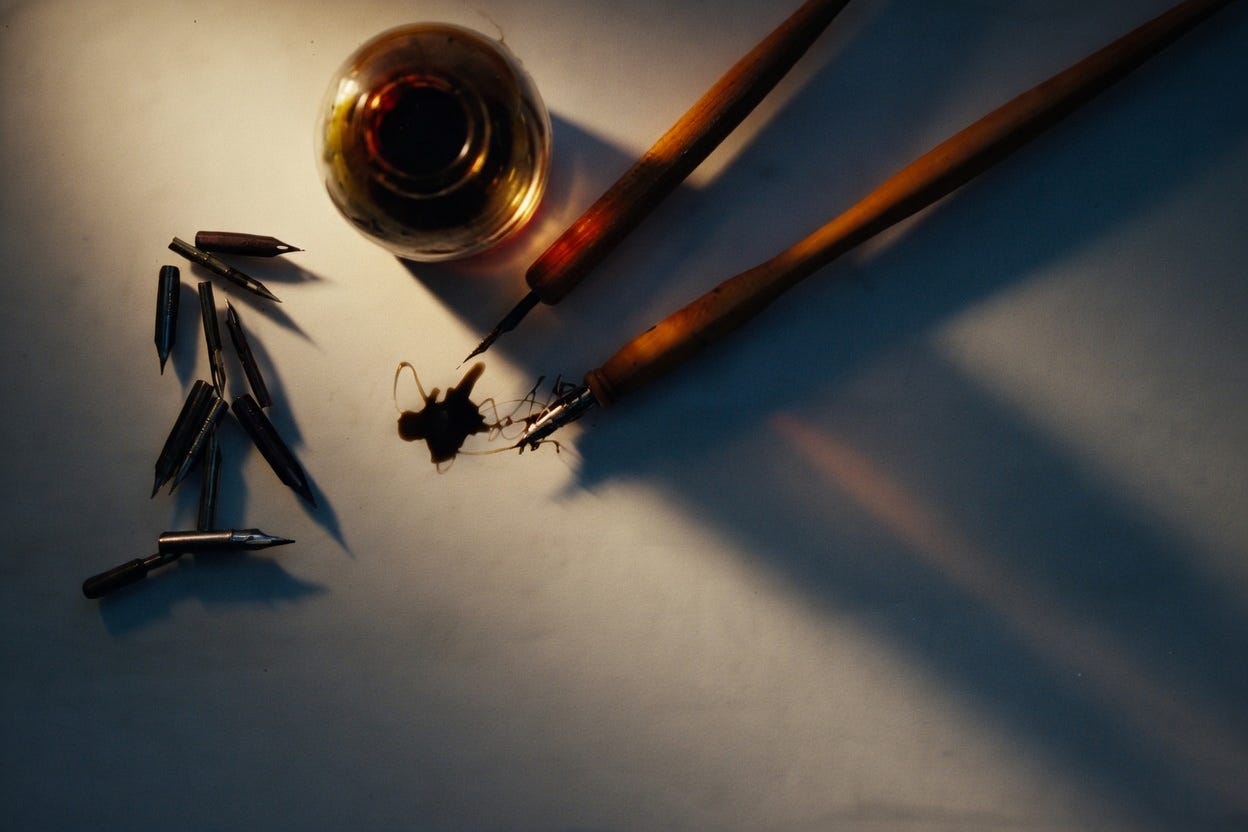
I collect dip pen nibs. Probably makes me archaic—I know. But every single nib has its own character, its own drag and flex, and there’s something genuinely magical about the resistance of a fresh one hitting paper. My second choice is a fountain pen, practical for on the go. Between the two I do most real thinking in ink.
The laptop is still where most of the work lands. But I’ve been migrating back to ink for anything that matters—manuscripts, original ideas, the messy middle. Not because it’s aesthetic. Because nothing else unsticks a thought like a doodle in the margin next to the sentence that’s stuck. That’s Bio-PoW in practice. As I’m currently in the UK — the government could probably ban dip pens as potential weapons before long and raid my home to seize them. Lol. Who knows. But as long as it’s on paper in ink, no one knows what’s on it. Not even the stuff from The Doughnut.
My high-signal work in 2026 shifts increasingly to these Dark Matter spaces. Tactile journals for the visceral thinking, only the final distillate touching the digital grid — and even that, not always.
A practical note: ink spills happen. When they do, the notebook page turns into what I can only describe as a black hole consuming your thoughts mid-sentence. Cleaning it up is its own creative process. Some people meditate. I prefer loud swearing. Releasing negative energy is underrated. Whatever. Not a guru.
This isn’t productivity hacking. It’s reclaiming cognitive output. Moving your thinking where scrapers can’t follow.
Practical blueprint
Where thinking actually starts: Fountain pen or dip pen on paper that deserves it—I use Dingbats, love the Orange Tiger. No sync. Preserve strike-throughs. Index pages for analogue lookup.
Distil weekly: Review and transcribe only the gold to an encrypted local vault (Obsidian self-hosted, no cloud AI).
Device-free sessions: Vinyl background. Walks with voice notes deleted post-transcription.
If you must keep a digital backup: SSD only. USB flash and cheap memory sticks degrade in a drawer faster than you’d think—charge leaks, data rots, years of work gone. An SSD is the only one I trust for long-term offline storage. No kidding.
Reset monthly: 72 hours zero digital in/out. Forces original signal.
Not anti-tech. Anti-total-surveillance. When compute becomes control, ink and paper is your personal firewall.
The 2026 Status Flex – Cultural Signals
The flex flipped. 2024 was latest AI gear. 2026 is Deliberately Slow.
Offline living is surging. Vogue calls digital detox a luxury status symbol. Gen Z and Millennials are reviving planners, commonplace books, snail mail, vinyl. Searches for analogue hobbies have spiked significantly across platforms in the past 12 months. Dumbphones, run clubs, letter-writing circles—it’s not fringe, it’s the counter-current to agentic overload.
When AI agents push the boundaries of oversight, the defence isn’t stronger digital walls—it’s making your mind illegible to prediction.
Sure, analogue can turn performative: premium pens as another consumable aesthetic, notebooks as status props. But the core signal is withdrawal from predictability. Friction you control beats frictionless capture every time.
Here’s where the line gets personal. I’ll be talking about something specific, phone supposedly off—and on my next time online I’m served an ad for exactly that thing. Not a conspiracy. I understand the technical side of how it happens. But understanding how something works doesn’t mean giving permission for it.
When I’m out in the wild I still use a printed map and a physical compass. Phone switched off entirely—which even then doesn’t guarantee privacy. So more and more I leave it at home when I hike. Safety? I’m Gen-X. Born and raised without a phone. The first time I saw a digital calculator I was already ten. I can code in C, I know the stack end to end—and I can walk for a full day entirely tech-free, barefoot if needed. Dinosaur? Maybe. But knowing exactly how the cage is built is precisely what lets you step outside it. That’s a longer conversation for another day.
Stay Un-Simulatable
Analogue isn’t hiding—it’s asymmetric warfare on the grid. Deny the models perfect simulation. Perform Bio-PoW. Become Dark Matter in a world trying to render you predictable.
This matters because when everything about you becomes data—process, hesitation, half-thought—the only power left is staying one step illegible. Not retreating from the future, but refusing to let it own your mind before you decide what to output.
In a world racing to simulate you perfectly, the ultimate move is to keep parts of yourself permanently off the map.
Dark Matters Matter.
un-simulatable (adj.)
Of a person, mind, or process: incapable of being accurately modelled, predicted, or reproduced by an artificial intelligence system — typically because the generative process itself was kept deliberately offline, non-digital, or otherwise outside the reach of training data. Distinct from merely being unknown to a model; un-simulatable implies an active, structural resistance to predictive capture. A person may be unknown to a system by accident. An un-simulatable person stays that way on purpose.
Coined by me | Jay @currenari, 19 March 2026.